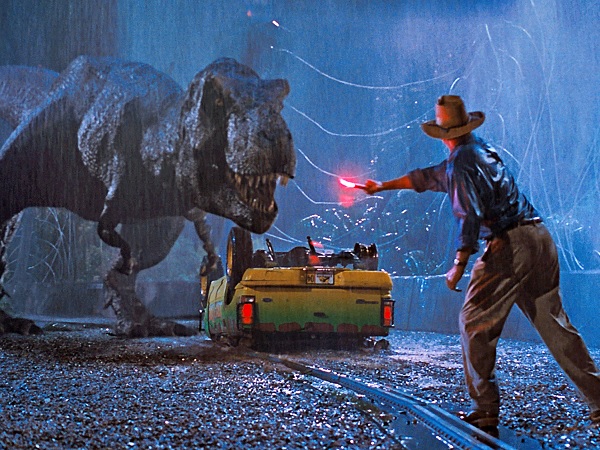
Time flies when you’re having fun, and it has certainly flown for Jurassic Park which this month celebrates its 30th anniversary. The film – directed by Steven Spielberg – made its debut on June 9th 1993, and proved that anything is possible in movie making, so long as you have imagination, innovation, and the right director with a desire to tell an incredible story.
Based on the book of the same name by Michael Crichton, Jurassic Park stars Sam Neill, Laura Dern, Jeff Goldblum, Richard Attenborough, Wayne Knight, and Samuel L. Jackson. The movie tells the story of a wildlife park, with real-life dinosaurs, that goes out of control when one of its employees temporarily turns disables the park’s security systems.
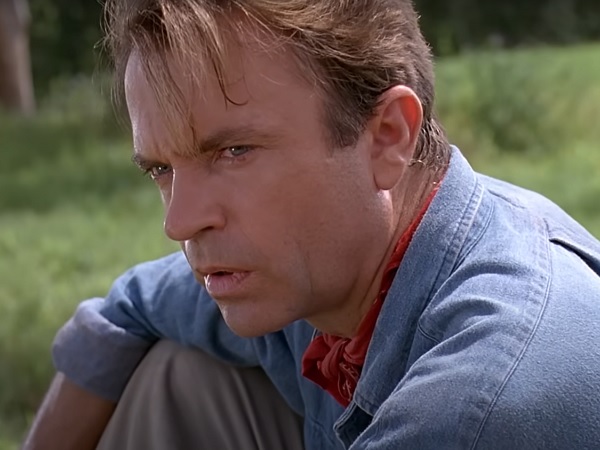
In the movie, industrialist John Hammond has found a way to clone dinosaurs using fossilised DNA. Utilising this technique, Hammond’s team of scientists have revived multiple species of dinosaurs, which are housed within a specially built wildlife park located on the tropical island of Isla Nublar.
This park – which Hammond has named Jurassic Park – is envisioned as the greatest destination in the world. Hammond has plans to open it to the public within a year, so they can marvel at the park’s star attractions, and he has spared no expense on getting it ready.
However, when a dinosaur handler is killed by a velociraptor ahead of the opening, the park’s investors become concerned about the safety of visitors (as well as any potential lawsuits). The investors call in a lawyer to check out the park, who in turn invites chaotician Dr. Ian Malcolm to the island, while Hammond invites palaeontologist Dr. Alan Grant and palaeobotonist Dr. Ellie Sattler to help support his vision.
At first everyone is wowed by Jurassic Park, but soon things begin to sour when a disgruntled employee sabotages the security system during a tropical storm. This provides the perfect opportunity for the park’s deadliest dinos to escape their enclosures, resulting in death and destruction as the formerly extinct creatures begin to take over.
Unlike many movies that are celebrating significant milestones this year, it’s difficult to believe Jurassic Park is turning 30. This is because while many films fade into the background for a while, only popping up again for anniversaries, it never really feels like Jurassic Park has ever gone away.
With five sequels released between 1997 and 2022, and countless merchandise (including some new stuff in the shops now), Jurassic Park has remained at the forefront of pop culture for decades. It continues to stand out as a key blockbuster from the ‘90s, which paved the way for many movies that followed, and it is still viewed very fondly by those who watched it back in ‘93.
I am one of those who saw it on the big screen when it made its debut, and I can tell you, it made a huge impact. I was around 11-years-old at the time, and seeing dinosaurs come to life and terrorise a theme park blew my mind.
And even today, I’m still bowled over by Jurassic Park. No matter how many times I watch the film, I’m in awe of its many accomplishments.
From the jeep chase sequence with the T-Rex, and the kitchen scene with the raptors, to Dennis Nedry’s encounter with a dilophosaurus, Jurassic Park never fails to entertain. The movie is carefully and cleverly put together to ensure there is suspense, tension, and sheer wonder throughout, and gosh darn it, it’s good!
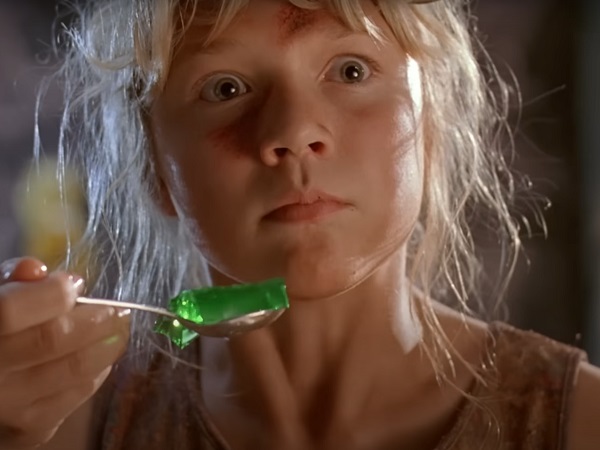
Director Steven Spielberg works his magic with Jurassic Park by balancing out all of the key set pieces and by never rushing to the dinosaurs too quickly. Although audiences are introduced to a velociraptor within the first four minutes of the picture, the deadly dinosaur is almost entirely kept off screen, with lighting and ear-piercing noises largely used to convey the creature to begin.
Five minutes later, there is a discussion about how dangerous raptors are, setting up their appearance later down the line, but it takes 20 minutes until the first dinosaur is properly seen. This dino is a brachiosaurus, which is shown in full, using ground-breaking CGI, and it is a breath-taking, scene-stealing sequence.
Spielberg then waits until almost an hour has passed until a storm hits the island, Dennis Nedry sabotages the security systems, and all hell breaks loose. Within this time, he provides the audience with plenty of exposition, to explain the science behind Jurassic Park, while filling in key details about the deadliest dinosaurs.
By the time the heavy hitters then show up (the T-Rex, dilophosaurus, and velociraptors – in that order), the audience is completely primed. By this point, no matter how much screen time they are given, all of these dinosaurs are signposted as dangerous beasts that mean business, and audiences know to be very afraid.
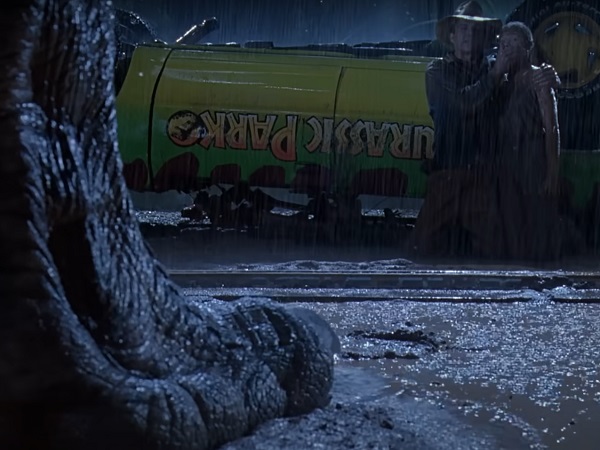
A number of deaths are used to highlight this, as well as plenty of eye-popping scenes of spectacle. The aforementioned jeep chase involving a T-Rex is one of these scenes, and it is as frightening as it is exhilarating.
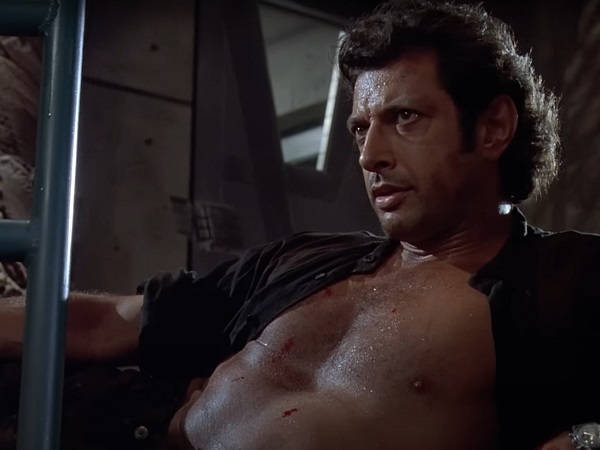
Technology has come a long way since Jurassic Park was released, but the tech used for the T-Rex sequence is still some of the best special effects work on screen. The combination of animatronics and computer-generated imagery ensures the whole thing looks seamless, even though it was a dino-sized ball-ache to shoot.
In fact, it’s amazing how Spielberg managed to pull any of this off. Not only did he have to create new technology to bring this story to life, but the shoot itself was plagued by problems with the animatronics, as well as a real-life hurricane that caused filming to be paused (footage of the hurricane can be seen in the film).
It’s also important to point out that Spielberg oversaw post-production work on Jurassic Park while in Poland, filming Schindler’s List. Both movies were released in 1993, and both are a testament to his skill behind the camera.
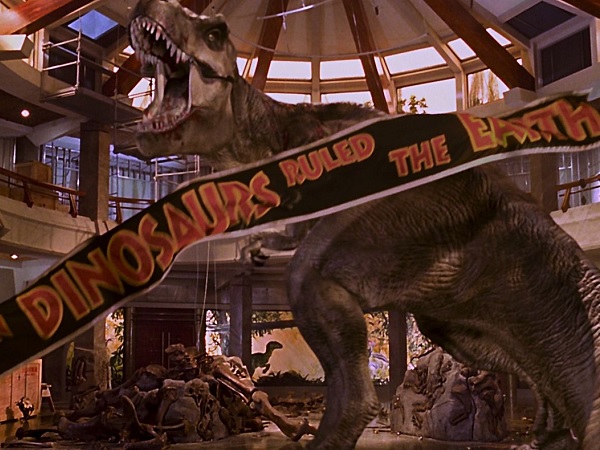
But it’s not just Spielberg that makes Jurassic Park the masterpiece that it is; everyone involved brings their A-game. From those in front of the camera, Neill, Dern, Goldblum etc, to those involved with the real nuts and bolts of the production, like cinematographer Dean Cundy, editor Michael Kahn, production designer Rick Carter, and the tech marvels at Industrial Light & Magic.
And then there is legendary composer John Williams who provides Jurassic Park with its magnificent score. Sound plays a hugely significant role in Jurassic Park, and between Williams and the sound department, the film is able to convey and invoke a range of emotions that go beyond just the visual stimulus.
All-in-all, Jurassic Park is the perfect example of everything and everyone coming together in the right way, at the right time, irrespective of any problems or obstacles. For 30 years it has stood the test of time, and I believe it’ll have no issues going on for another 30 years and more.
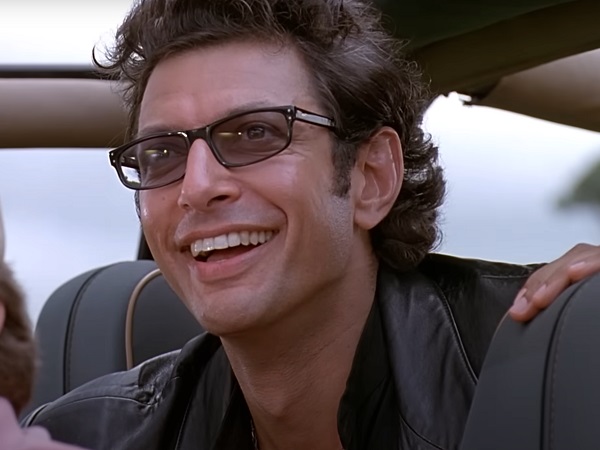
Should you wish to revisit Jurassic Park for its 30th anniversary, the movie is currently streaming in the UK on Now TV. The movie is also widely available on DVD, Blu-ray, 4K, and all major digital platforms.
On June 26th, a limited edition Jurassic Park 30th Anniversary 4K Ultra HD box set is also being released, which includes the film along with a collection of supplementary material (art cards, book, film cel, etc). This will be available from all major home video retailers.
And if all that wasn’t enough, later this year an event called Jurassic Park 30th Anniversary: In Concert will be making its away around the UK covering locations including Manchester, Liverpool, Nottingham, Birmingham, and the Royal Albert Hall in London. This is a special screening of the movie, which is accompanied by a live orchestra.
__
Thank you for taking the time to read this review on It’s A Stampede!. For more reviews, check out the recommended reads below.


Leave a Reply