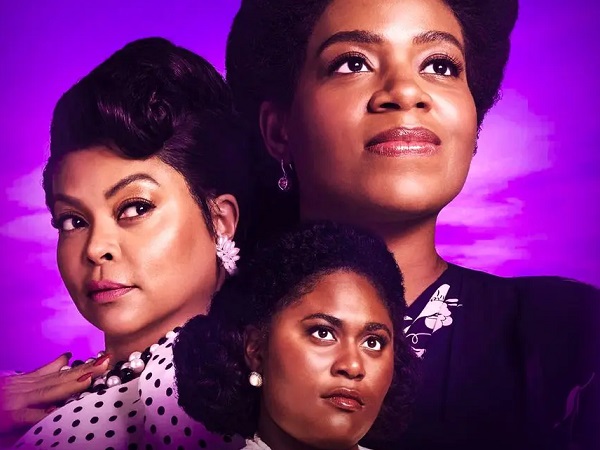
Isn’t it typical? You wait ages for a good musical to come along, and then two turn up at once.
Last week the musical version of Mean Girls arrived in UK cinemas, and this week it’s the turn of the musical version of The Color Purple. The film – from director Blitz Bazawule – opened in the US on Christmas Day and now it is finally available to watch in UK cinemas from today.
Similar to Mean Girls, The Color Purple originated as a book, before being turned into a movie, then a stage musical, before finally being transformed into another movie based on the musical. And as with last week’s Mean Girls, this is another strong adaptation and a great movie to go out and see during this rather dreary (and never-ending) month of January.
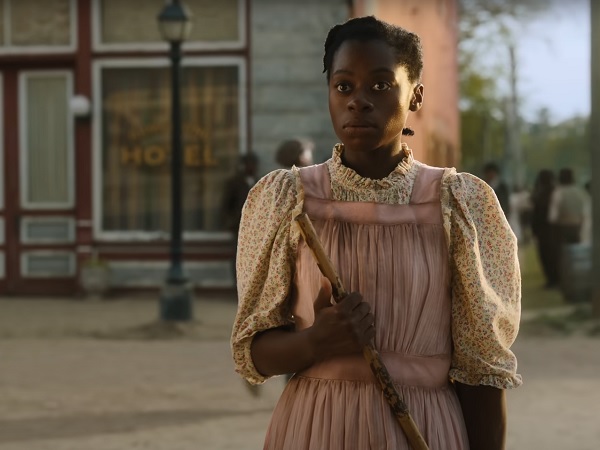
Set in the American South during the early 1900s, and starring Fantasia Barrino, Danielle Brooks, Colman Domingo, Taraji P. Henson, Corey Hawkins, Halle Bailey, and Louis Gossett Jr., The Color Purpletells the story of a young African American woman named Celie. The film follows Celie’s life from her early days, right through to her latter years, with a particular focus on the hardships she faces as an adult.
In the film, Celie lives with her loving sister, Nettie and their abusive father, Alfonso. Their mother passed away some time ago, and ever since her death, Alfonso has been sexually assaulting Celie and has his eye on Nettie.
But when Nettie comes of age, she attracts the attention of local farmer, Albert ‘Mister’ Johnson. ‘Mister’ asks Alfonso if he can marry Nettie, but Alfonso refutes the suggestion and offers up Celie instead.
After agreeing to the proposition, ‘Mister’ takes Celie away to live on his farm, where he treats her like a servant, makes her look after his children, and sexually assaults her. Celie’s role is to cook, clean, and do whatever he says, with no talking back and no refusals.
Over time, Celie’s life becomes a nightmare. She is forbidden from seeing her sister, and she becomes brow-beaten.
However, as the year’s pass by, some light does begin to shine in her dark life, due to the arrival of jazz singer, Shug Avery. Celie also learns about Nettie’s new life in Africa, where she is free from their father.
You know, when I first heard a new adaptation of The Color Purple had gone into production, I was very sceptical. The previous adaptation from director Steven Spielberg, which starred Whoopi Goldberg, Oprah Winfrey, and Danny Glover, was excellent and I couldn’t see the real need for another.
Then when I heard this second iteration was going to be a musical, I was even more dubious. Having seen the previous film, and having read the original book by Alice Walker, I wasn’t sure The Color Purple was the sort of film that would lend itself to music.
For those who have never seen the previous film, or who have never read the book, The Color Purple contains some very bleak moments. Sure, there are a few hopeful scenes, but for the most part it is heavy hitting stuff and as far as I could see, certainly not something to sing and dance to.
If The Color Purple is to be turned into a musical, then what next, Schindler’s List?! Surely, there are some films that simply don’t need to be put to song?
Well, apparently not, and it’s here that I will openly hold up my hands and say I was wrong. If done right, a novel such as The Color Purple CAN exist as more than one adaptation and it CAN be transformed into a musical.
This is not to say this version of The Color Purple is perfect, and doesn’t have flaws, but it is to say this is an excellent film. Director Blitz Bazawule, as well as everyone involved in this production has worked hard to ensure this movie is entertaining while also respectful to the material.

In terms of the casting, the film gets it completely right. Not one part is badly cast in this picture, and everyone sells the heck out of their performance.
The stand-out turn comes from Fantasia Barrino who plays the role of Celie. Barrino reprises the part from the stage show, and thanks to her careful handling of the character, she wows audiences on screen in the same way she wowed them on stage.
The same goes for Danielle Brooks, who plays the part of Celie’s friend Sofia. Brooks also reprises the role from the stage show, and does a stellar job of bringing the no-nonsense Sofia to life.
Outside of these two, Taraji P. Henson is great as Shug Avery, Corey Hawkins is good as Harpo, and Halle Bailey does a solid job as Nettie. Bailey – who starred in last year’s The Little Mermaid – doesn’t get a great deal of screen time, but she makes the most of what she has.
And then there is Colman Domingo, who is excellent as ‘Mister’. Danny Glover provided an unforgettable turn as ‘Mister’ in the original film from 1985, yet Domingo is equally as strong here, bringing a hard edge to the character.
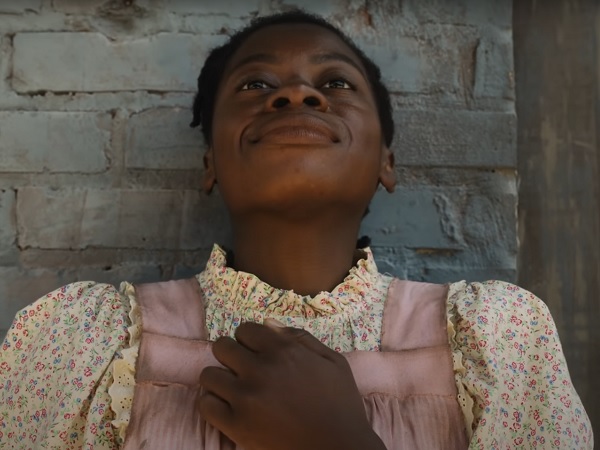
Moving away from the cast, and The Color Purple benefits from smart direction, some great staging, and a belting collection of songs. Pretty much all of the tunes slot into the drama perfectly, and accompany the story well.
Occasionally the songs (and some of the choreography) do throw the tone off a little, and this does mean the picture has the occasional stumble, but for the most part it’s not a problem. The serious nature of the story, as well as the more harrowing scenes in the film remain in tact, and this ensures things don’t fall into dismissive, happy clappy territory.
I was worried the songs would be poor, distracting, or dismissive. They are not.
To be clear, despite the inclusion of music, this isn’t a sanitised version of The Color Purple. OK, so it doesn’t feel quite so raw as the Spielberg version, but it isn’t any less impactful when it needs to be.

Thanks to strong performances, a good collection of songs, and the right approach, The Color Purple proves that two versions of the same story can exist on screen, and can both be worth the time and effort. Sure, everyone will have their favourite version of the story, but this new take on The Color Purple stands tall and is certainly not a poor relation.
Whether you’re new to the story or not, The Color Purple offers something to really get invested in. Alice Walker’s original novel shines bright on screen for the second time, and is as emotional and moving as it has ever been.
__

__
Thank you for taking the time to read this review on It’s A Stampede!. For more reviews, check out the recommended reads below.
 It's A Stampede!
Leave a comment